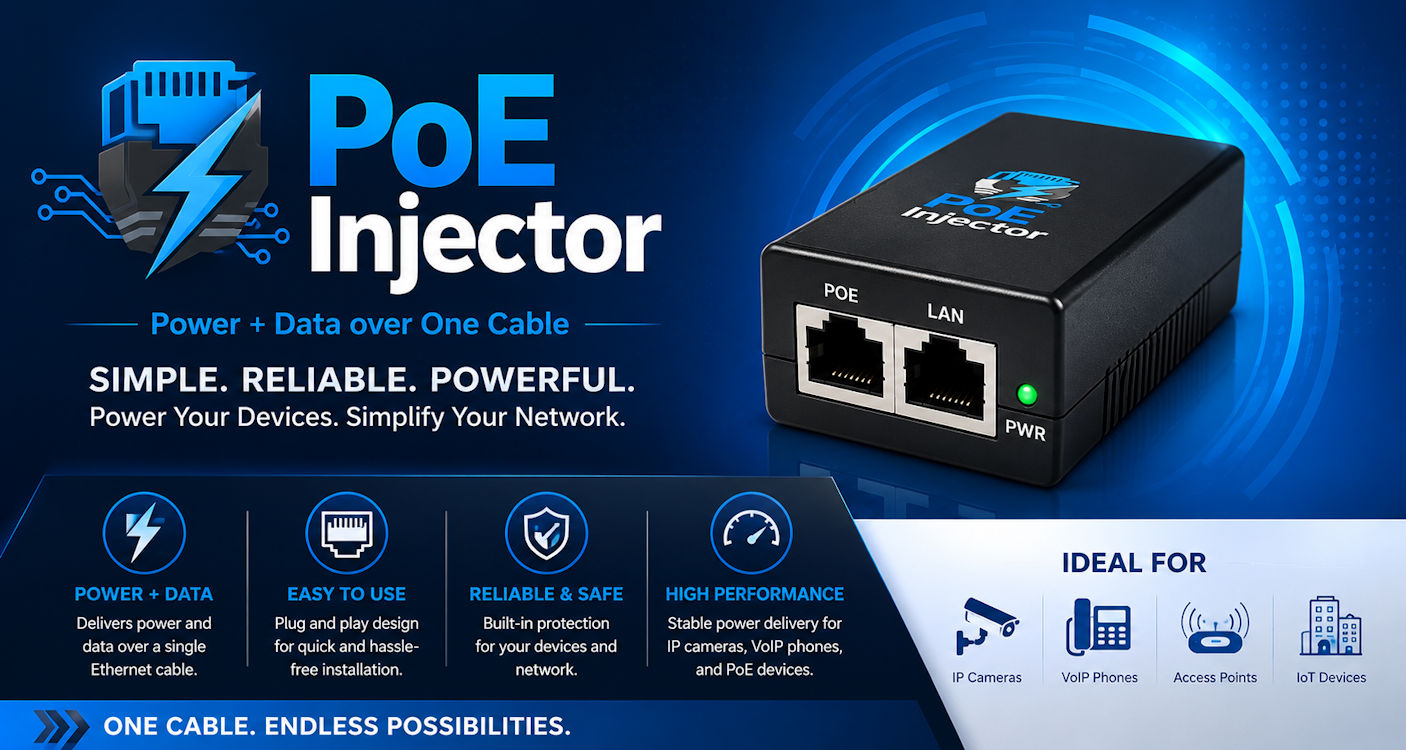
A Power over Ethernet (PoE) injector is a simple, efficient way to deliver both power and data to a compatible network device through a single Ethernet cable. By combining connectivity and electrical supply in one line, it removes the need to install a separate AC outlet near each device. As a result, network deployment becomes cleaner, faster, and more flexible.
PoE injectors are especially useful when you want to place devices in locations that are difficult to reach with traditional power, such as high ceilings, exterior walls, parking areas, or other remote mounting points. With one standard Cat5e or Cat6 cable, you can extend both network access and power. This allows you to avoid the cost and hassle of running separate wiring.
Using a PoE injector is straightforward. First, connect a non-PoE network switch or router to the injector’s LAN port. Next, plug the injector into a standard wall outlet. Finally, connect your PoE-compatible device, such as an IP camera, VoIP phone, or wireless access point, to the injector’s PoE port. Once connected, the injector supplies the power and data needed for the device to operate.
Choosing the right standard is important for reliable performance. 802.3af (PoE) provides up to 15.4W and is ideal for basic IP cameras and standard VoIP phones. In contrast, 802.3at (PoE+) delivers up to 30W and is commonly used for PTZ cameras, access control terminals, and dual-band wireless access points. For more demanding equipment, 802.3bt (PoE++) offers up to 60W or 100W. This makes it suitable for high-power devices such as outdoor dome cameras with heaters or advanced AV equipment.
For best results, select a Gigabit injector with 10/100/1000 Mbps support to avoid network bottlenecks and maintain strong data performance. It is also critical to match the injector to your device’s power requirements. This is especially critical because many professional security cameras need 48V to 54V power. Active injectors are the safest choice for most installations because they negotiate power before delivery. In contrast, passive injectors send continuous power immediately and can damage non-PoE devices if connected incorrectly.