
Megapixel vs TV lines
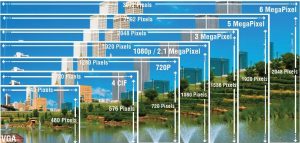
We are glad to write the addition of a new frequency asked question article, this time giving a little clarity to what difference between TVL and megapixel, how TVL measurements compare to pixel measurements in PAL, NTSC, and IP CCTV systems.
For conventional video surveillance cameras, they are analog cameras that output analog TV signals. Accordingly, the TV line is used to refer to the image resolution that the camera can capture. The resolution of the image mainly depends on equipped CCD/CMOS image sensor. Based on different CCD/CMOS image sensors, an analog camera can deliver standard resolution video with 700TVL, 650TVL, 480TVL, 420TVL, etc. A higher TV line means a higher resolution. Now, network camera becomes the mainstream, network camera outputs digital signals, manufacturers use pixels to refer to the image resolution, such as 0.3 megapixels, 1 megapixels, 1.3 megapixels, 2 megapixels, 3 megapixels, 5 megapixels, even 8 megapixels ultra-high definition. A higher pixel means better image quality and higher resolution.
A television line is a distinct vertical line, alternately black and white, which can theoretically be displayed on a video image from a camera or on a screen. So, 400 TVL would mean that 200 alternating dark and 200 light vertical lines can be captured/displayed by the camera/monitor. This explanation is complicated, however, by the fact that the horizontal resolution is expressed concerning vertical resolution, in effect showing what the horizontal resolution would have been if the TV were square. But TVs are not square, and nor are camera images, indeed they tend to be 4:3.
Respectively, as the video recording and storage devices, Digital video recorder also has different resolution to define its video compression capability such as QCIF, CIF, HD1, D1 (FCIF), 960H (WD1), etc. A typical analog video surveillance system mainly composes of several cameras and DVRs. To achieve the required video surveillance quality, both cameras and DVRs should have the same resolution specification, or DVRs may support higher resolution recording capability.
Many clients will confuse between pixel and TV lines, recently we have been asked many questions about the conversion between pixel and TV Lines. If you are also feeling confused about them, you can check the following table.
| Device | TVL/Pixel | Effective Pixel NTSC | Effective Pixel PAL | Total NTSC | Total PAL |
| Analog SONY | 480TVL | 510H*492V | 500H*582V | ≈0.25 megapixel | ≈0.29 megapixel |
| 600TVL | 768*494 | 752*582 | ≈0.38 megapixel | ≈0.43 megapixel | |
| 700TVL | 976*494 | 976*582 | ≈0.48 megapixel | ≈0.56 megapixel | |
| Analog SONY CMOS | 1000TVL | 1280*720 | ≈0.92 megapixel | ||
| IP Camera and NVR | 720P | 1280*720 | ≈0.92 megapixel | ||
| 960P | 1280*960 | ≈1.23 megapixel | |||
| 1080P | 1920*1080 | ≈2.07 megapixel | |||
| 3MP | 2048×1536 | ≈3.14 megapixel | |||
| 5MP | 2592×1920 | ≈4.97 megapixel | |||
| DVR and NVR | QCIF | 176*144 | ≈0.026 megapixel | ||
| CIF | 352*288 | ≈0.1 megapixel | |||
| HD1 | 576*288 | ≈0.16 megapixel | |||
| D1(FCIF) | 704*576 | ≈0.4 megapixel | |||
| 960H | 928*576 | ≈0.53 megapixel | |||
In the past, the high definition (HD) refers to megapixel resolution, and now there is Ultra High Definition (4K) which is 8 megapixels. In the market, there is Full HD, which means the video image’s length and width ratio is 16L:9W, which normally means 1920*1080. The “Full” character especially refers to the “16:9” ratio, as in the early days, there is no unified standard, there are also other ratios like for example, 4:3.
